


"When Is It Abuse?"
"So how do you know whether you're in an abusive relationship? Experts suggest that the most important indicator is how you feel—which is ironic, considering that if the other is abusive, you probably have difficulty trusting your feelings. However, the following are some helpful questions to ask yourself :
- Do I feel afraid of or intimidated by the other—physically or emotionally—during times of conflict?
- Do I feel respected by the other?
- Are my ideas, feelings, and needs listened to and taken seriously?
- When I share concerns about our relationship, does the conversation end up getting turned around and focused on what I'm doing wrong?
- Do conversations never seem to be productive, no matter how hard I try to communicate effectively?
- Do I often feel guilty?
- Am I overly focused on the relationship, always trying to figure out how to make things better?
- Do I feel crazy?
- Does my mood depend on the state of my relationship?
- Does the other play hard to get, keeping me always unsure of where I stand and feeling insecure?
- Has my self-confidence decreased?
- Is it increasingly difficult for me to trust the truth of my experience?
- During times when we are not in conflict, do I worry that what I say or do will later be used against me?
- Does the other take responsibility for their part in a conflict, and do they actually make changes (and not just temporary ones) to reduce the likelihood of such conflict being repeated?
- When I try to hold the other accountable for hurting me, do I get called "high maintenance," "a nag," or other insults?
- Do I feel silenced?
- Does the other experience me as controlling whenever I challenge their control?
- Do I feel "less than" and ashamed in this relationship? Do I feel that my self-worth has decreased and that it's not honored?
Moreover, in abusive relationships, anger is rarely, if ever, tolerated – unless it's the abuser's anger. If the person being abused were allowed to feel their own anger, they would be less likely to tolerate the abuse. A key strategy abusers use to ensure that the nonpowerholder doesn't feel anger is to make sure that the nonpowerholder doesn't recognize that they're being treated unfairly. And often, the abuser reacts to the nonpowerholder's anger punitively, making the nonpowerholder's expression of anger dangerous. “For example, when an employee expresses to their abusive boss even mild frustration over what they feel is an unfair amount of work they've been given, the boss may go on a tirade, listing all the sacrifices the boss makes for the department and accusing the employee of being lazy and ungrateful; or the boss may act disappointed and offended and withdraw, giving the employee the silent treatment. In both instances, the message communicated is that there will be a price to pay for any expression of anger directed toward the abuser.”
Abusive relationships are traumatic relationships. The person being abused will almost inevitably experience some symptoms of posttraumatic stress.16 Often such symptoms continue even after the relationship has ended. Posttraumatic stress is not a sign of weakness but rather a natural reaction to being abused; with understanding, it is often entirely treatable.
If you believe you may be in an abusive relationship, be aware that such relationships involve dynamics that go beyond the scope of this book and that often, the way to get such a relationship right is to end it. If you feel fearful for your physical safety for any reason, then it's vital that you take immediate steps to protect yourself and others in your family; see the accompanying note for helpful resources.
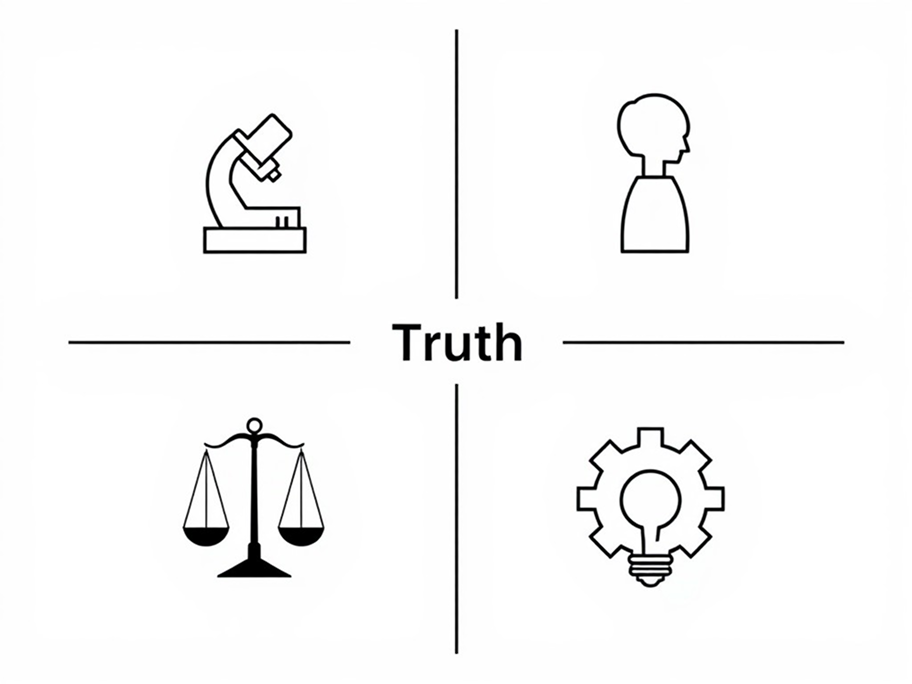
Truth and fact overlap but are separated by a thin veil that often seems impenetrable.
The notion of “truth” shifts depending on context. Legal training commonly explores four “quadrants of truth”: objective truth, subjective truth, normative truth, and pragmatic (or practical) truth. Each quadrant holds distinct value based on its applicability and relevance—making them also “economical truths.” Understanding this diversity and contextual fluidity is crucial for effective communication and decision-making.
The #MeToo movement, alongside numerous cases of abuse, bullying, and manipulation , offers a vivid example of how these four quadrants of truth intertwine.

In artificial intelligence (AI) and machine learning, there is a term called GIGO - "Garbage In, Garbage Out," meaning that if you feed a language model with flawed, garbage-like data, the output will also be flawed as garbage.
When systems — whether cognitive circuits, legal frameworks, AI models, or medical diagnostics — evaluate real-world situations, they often interpret data by mobilizing resources from these four quadrants of truth, However, errors in interpreting or applying truth can lead to confusion. This is where the confusion matrix (commonly used in machine learning) becomes relevant, as it helps categorize how well predictions align with reality:
In abusive relationships, survivors may take more than a decade to fully recognize and name what has happened to them. Even after enduring violence, it often requires significant time and effort to move from a state of denial to acceptance. The acronym "DENIAL" — "Don't Even kNow I Am Lying" — reflects how individuals may unconsciously deceive themselves to avoid confronting painful truths. It can take the cognitive system considerable time to acknowledge that someone who once love-bombed them is also an abuser.
Historically, an example of medical misjudgment is the now defunct diagnosis of hysteria — for nearly two millennia, male-dominated medical authorities believed hysteria was a female-only disorder caused by a wandering uterus or sexual repression. The prescription is for male doctor to penetrate women or give women sexual orgasm. The belief persisted until the late 20th century, when the term was finally discredited and recognized as a misclassification of various psychological disorders. Such misjudgment highlights the tainted consequences of patriarchal-centered value and its biased information system.
Similarly, legal systems, influenced by varying evidence and the value judgments of prosecutors and judges, can produce biased outcomes. Gaps in evidence, statutes of limitations, and societal stigma often hinder survivors from establishing their subjective truth. Meanwhile, perpetrators immersed in misogynistic cultures, power, or driven by narcissistic tendencies, may believe they have done nothing wrong. These conflicting subjective truths further obscure the pursuit of justice, plunging the truths into confusion.
Within the AI realm, an notorious case is that George Washington University law professor Jonathan Turley who was falsely accused of sexual harassment by ChatGPT. The chatbot mistakenly generated a claim that Turley had been involved in a sexual harassment incident in a school trip to Alaska, citing a fabricated article from The Washington Post. Turley has never taught at the institution mentioned, never took the trip described. Yet since the news is created by a poisoned AI, there was no real journalist or writer to correct from. What's more, after Jonathan Turley advocated for his case, the seemingly omniscient ChatGPT now can't produce any anwer related to his name. All mentions and any related news are censored, even just to translate the related information, ChatGPT is hard-programmed to malfunction in creating relating outcome.
Whether in one's brain, or in medicine, law, or AI, the most concerning challenges in each domains lie in false positives (FP) (e.g., wrongful accusations) and false negatives (FN) (e.g., failing to identify genuine victims or perpetrators). These errors occur when a judgment system mistakenly treats flawed data or incomprhensive database as sufficient evidence, leading to flawed conclusions — or worse, revealing the system itself has largely wrong or needing modification. When a system makes a false positive (FP) claim, it's often possible to gather evidence to prove guilt —but proving innocence is more complex. What evidence can one provide to establish definative innocence? of nothing happened? Conversely, for surviors of abusive relationships or sexual violations, the lack of witnesses or the survivor's shame and denial may lead to the difficulty to prove harm. This lead false negative (FN): legitimate claims being dismissed or overlooked, harmed experiences unrecognized and unresolved.
Decades ago, incidents such as being inappropriately touched by a boss or harassed by a spouse were frequently downplayed or dismissed by society. They were often blamed on women or brushed off as a man's way of flirting. Over time, movements like #MeToo have shown that exposing these injustices and creating genuine accountability is a lengthy, complex process. Survivors must gradually assemble what I call “resources” from four quadrants of truth—subjective, objective, normative, and pragmatic—to ensure that each new truth they reveal becomes new reality, and shields them from manipulative rhetoric.
Survivors draw upon psychological resilience, legal channels, communication skills, and support networks to build truths from each quadrant. They share subjective truth of personal experiences, seek validation through objective truth in the form of evidence or legal proceedings. They emphasize normative truth to challenge society's ingrained misconceptions about power and gender, ultimately relying on pragmatic truth to drive systemic change.
In my own writings, I have not revealed the identities of those who subjected me to sexual or emotional abuse. This choice does not imply these incidents never occurred or that I am reluctant to speak. Rather, it underscores how long the journey can be from subjective truth to normative and pragmatic truths. While legal process demand exhaustive evidence and are constrained by statutes of limitations, it is a system that is not yet to establish (objective) truth for many survivors.
Even with years go by, the trauma remains vivid, yet perpetrators frequently believe they did nothing wrong. Structural abuse—whether rooted in patriarchal misogyny, power imbalances, or abusive personality networks runs so deep that obscuring both victim and perpetrator in understanding their respective roles. Until additional “truth resources” become accessible, ambiguous writings and the “whisper networks” that circulate among the oppressed serve are among the actions taken to construct different forms of truth.
After all, after all these survival years in struggles, ambiguous writings, advocacies, and facing the counter-effects of activism … quoting from Gisele Pelicot: I want some day that the shame will shift from the survivors onto the prepertrators. I still want one day, that they will know their wrongs and repent.