

It started from casual conversations in several hangouts in several places in the city of Jogja, such as at IVAA (Indonesian Visual Art Archive), at Angkringan, (a very local and cheap food and beverage kiosk, that can be found in the pedestrians in Yogyakarta) and coffee shops in the southern part of Jogja and its surroundings. Conversations about censorship and expressions often run randomly, in conversations during breaks in the work in the arts and culture sector that we do daily. The participants of this workshop are my good friends, and we usually share our ideas, unhappiness, and even social anxiety, while I was living and working in Jogja. While in Jogja, we have been involved in several arts and community-based archive-based work. Not infrequently we use performances, exhibitions, workshops, or tours as a way or method to revive memories, explore buried emotions, and at the same time dig up hidden knowledge that exists around us. We then place this project as a means to restructure our random conversations around censorship.
We start by identifying the forms of censorship and surveillance that are present around us. Ghozali reminded us that we already have CCTV at many points in the city, which can be accessed from this website https://cctv.jogjakota.go.id/. The question that arose at that time was: through the practice of using CCTV, can we then explore further our memories around censorship, the new order, and various forces that consciously or unconsciously influence us in expressing or experiencing our own feelings? When we pull back, we can also dig into our memories around the New Order era or before 1998. Because many assume that the reformation was an important turning point for the pace of democracy in Indonesia, we want to re-examine whether the situation after 1998 can be called the era of post-censorship, or how we see ourselves amid today's situation, amid the reformation that has been going on for more than twenty years today?
This workshop was conducted with a series of casual discussions in several locations, namely at IVAA and at one of the CCTV points. This discussion was conducted by Dwi Rahmanto, Irfanuddien Ghozali, Krisnawan Wisnu Adi, and Febrian Hasibuan and moderated by Lisistrata Lusandiana. This series of discussions cannot be separated from our daily lives as artists and our work experiences with the community. The second thing also cannot be separated from our presence in the city of Jogja, in which some of us were born and raised in the city of Jogja, while some of us were born outside the city, and work and create in Jogja. So this workshop cannot be separated from discussions about practice, ethics, and aesthetics. Before the workshop, we had a chance to discuss our brief experiences around the New Order, censorship and cancellation of performances or stages, and how the regime did not like some expressions that were present through performances. In addition, as citizens of cyberspace, we also have a reluctance to express opinions or share our daily lives. Have we lost our raw emotions? How do we define post-censorship today? Through this workshop, we explore questions such as "Where are we in this city?" "Where is our position in society?", and "What are we made of?" and how do we redefine empowerment into mutual empowerment ?
a. Public Art
August 18th, 2024 we deliberately took one CCTV point in the Malioboro area. Sitting in a circle on the pedestrian, just chatting while enjoying the afternoon sunset. Hanging out on the sidewalk means that we also share space with other passersby, tourists, and local residents, along with food and beverage vendors. Some passersby tried to approach Miskha, the adorable furry bestie of Lisistrata and some others were afraid maybe because it was considered najis or dirty in the Islamic frame. The conversation felt performative. Being watched, glanced at, and sometimes answering questions from people who were just curious about Miskha. All those things were mixed on the pedestrian, in the public space.
Public space is a performative site in which various values and interests are rolling and competing with each other. Art is also part of this site. In addition to being watched or just glanced at, it is also very possible to be monitored, in order to intervene in certain performativity. Our simple conversation is an experience, a metaphor, and a reflection of that.
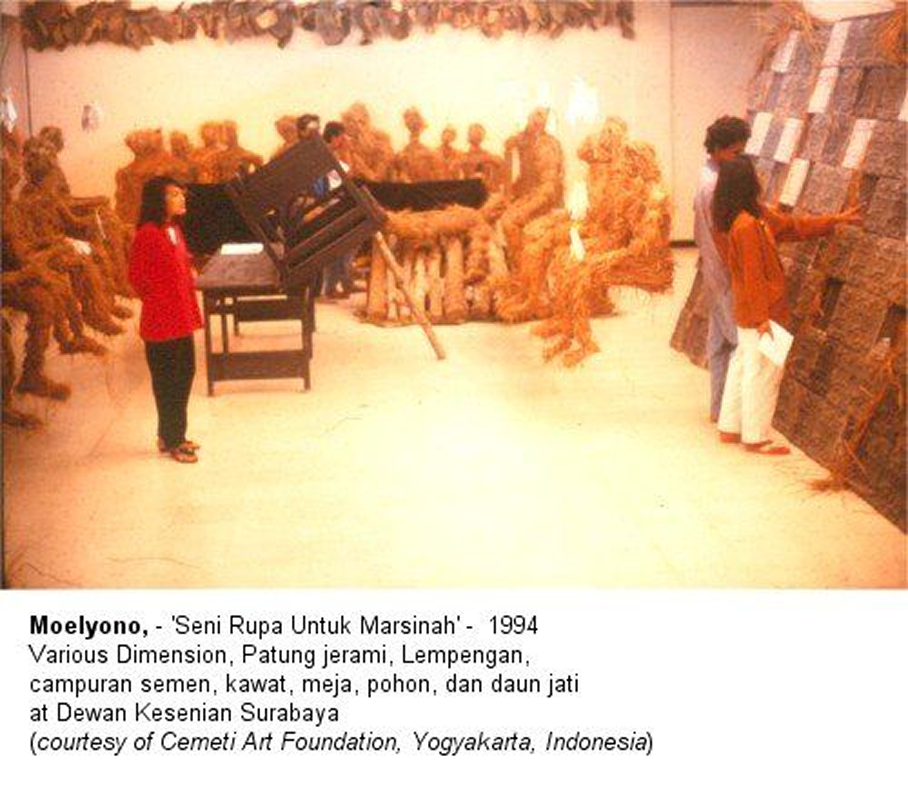
Memories, references, and imaginations during the New Order cannot be denied as important epics. Many records show that art is very closely related to censorship. One of the examples is Moelyono's work of art. Collaborated with the Community of Fine Arts Foundation (YSRK) and the Solidarity Committee for Marsinah (KSUM), they planned to hold an exhibition on 12-16 August 1993 in the exhibition hall of the Surabaya Arts Council (DKS) Building with the title "Fine Arts Exhibition for Marsinah: Remembering 100 Days of Marsinah's Death". Unfortunately, the afternoon before the opening, the exhibition was banned by the police. Usually, DKS does not need to ask for permission for every exhibition they hold. As a result, Marsinah's family who were invited did not cut the ribbon to mark the opening. A sad censorship at the time of the 48th Indonesian Independence Day when just and civilized humanity is actually denied.
Several years earlier, Teater Koma also experienced censorship. The performance "Maaf, Maaf, Maaf" which means "Sorry, Sorry, Sorry" was banned from being held at several campuses in Bandung, Yogyakarta, and Surabaya in May 1978 because it intended to discuss the authoritarianism of the rulers at that time. In 1988-1989 it was the same. The performance "Sampek Engtay" was intimidated and banned twice by the rulers.
Art is both a part and a depiction of social reality. The art cancellation depicted the character of the rulers towards the public at that time: oppressive, racist, and always worried. The span of 32 years has fostered boredom. The 1998 Reformation then became a momentum to reclaim public space. Art was also not spared from that.
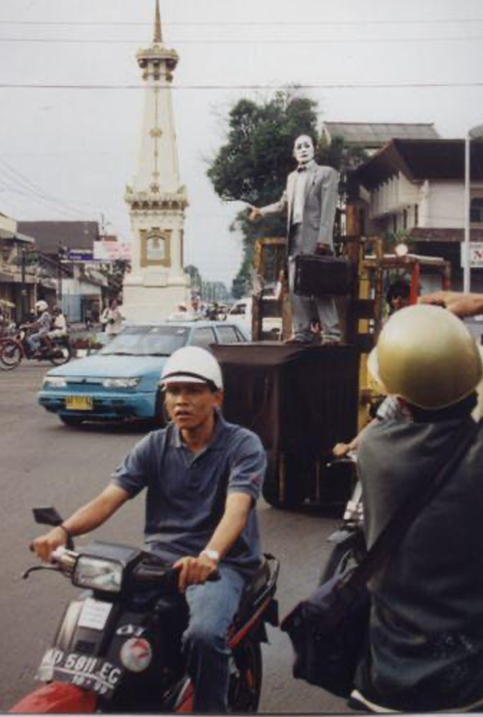
One of them was the Public Art Action in Yogyakarta from June 21 to July 7, 1998. Artists from Yogyakarta and its surroundings spontaneously and independently held an exhibition of their works in order to support the 1998 Reformation. Written in the pamphlet, "Monetary crisis, economic crisis, moral crisis, political crisis, intellectual crisis, creativity crisis, information crisis, or cultural crisis in the broadest sense express themselves in their most concrete forms". Therefore, all prohibitions are no doubt just a cover for the rottenness in the name of order. Together with other social elements, art gets its "freedom". Public space truly becomes a site of non-trivial struggle when the space of hope fights with the representations maintained by the authorities.
Then, did censorship disappear completely after the 1998 Reformation? It seems that the rottenness of the regime has spread to all corners. Its stench is carried by maggots to corners that were previously unthinkable. On March 13, 2006, the Union of People Who Enjoy Aesthetics and Ethics (Soneta) held a protest against the Draft Law on Anti-Pornography and Porno-Action (RUU-APP) in the yard of the Department of Regional People's Representatives of the Special Region of Yogyakarta (DPRD DIY). Several artists involved were Marwoto, Yuswantoro Adi, Hadi Susanto, Jemek Supardi, and Kuss Indarto. This rejection was based on the argument that the RUU APP threatened the diversity of art and positioned women only as objects of regulation.
The representation of the body, which was previously not a problem for the New Order, actually became a matter exposed in the post-1998 Reformation era. Censorship is still operated to continue to seize public space. However, one thing that is quite different is that this time populism has become an approach that is in the name of, once again, the interests of the people.
Adrian Jonathan Pasaribu's research collaborated with Arts Equator shows this tendency. In the period 2010-2020, there were 128 cases of censorship of arts and cultural practices including film, visual arts, performing arts, music, multidisciplinary, publication, tradition, and online form. As many as 73 cases of that were intimidated and banned with several legal products, namely the 1965 Blasphemy Law, 1966 Anti-Communism Law, 2008 Pornography Law, and the 2008 Information and Electronic Transactions Law. Some examples of arts and cultural events that were banned are Lady Fast, Q! Film Festival, Porseni Transvestite-Bissu, Maknawi Kidung Maria dance performance, Tan Malaka monologue, etc. (we can read further from Koalisi Seni's publication)
Censorship of arts and cultural practices is not always operated vertically. Through a populist approach, the regime does not lose its wits to continue trying to control the public space. Horizontal issues are used as a pretext. Adrian in his research above also wrote that in the post-1998 Reformation era, a narrative of "sensor mandiri" (literally means self-censorship) emerged which was first promoted by the Film Censorship Board of the Republic of Indonesia in 2015. This is slightly different from the concept of self-censorship which tends to be "without pressure". "Sensor mandiri" is more of a rhetoric used by the authorities under the pretext of media literacy that democratizes cultural life in Indonesia. It strengthens the idea that the public is invited to always be vigilant with the information that is scattered. This narrative legitimizes the regime to continue to spread its control over the arts and cultural practices. The struggle of art for the realization of the public sphere faces challenges that are not easy. How could it not? In addition to the authorities, an art event can also be intimidated by mass organizations.
The evolution of censorship from the New Order era to the post-1998 Reformation is something that deserves to be continuously recognized. The horizontalization of censorship (populist approach) and pseudo-democratization of censorship ("sensor mandiri") can be used as a starting point to see that the control of the authorities is becoming more subtle.
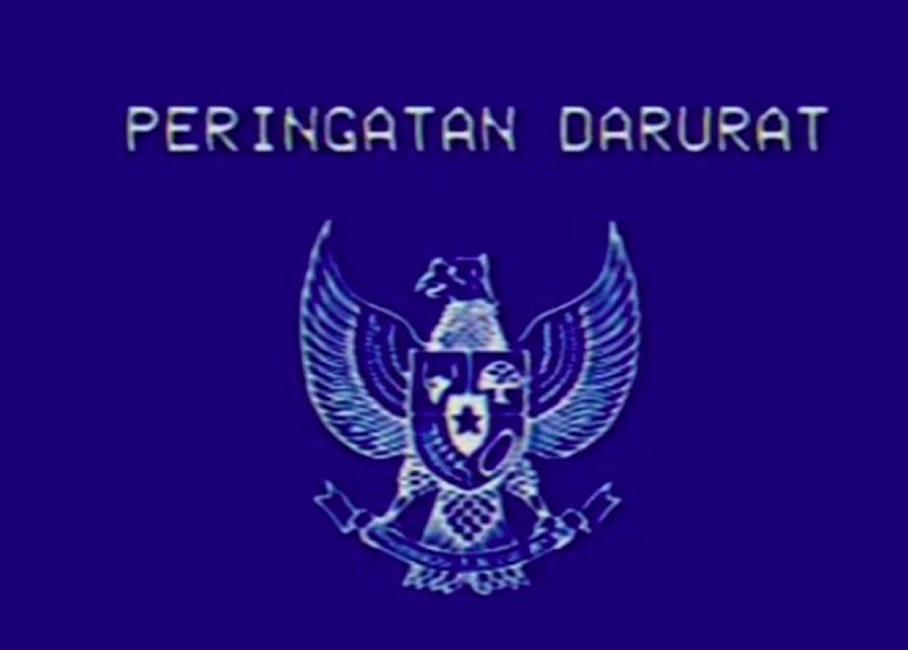
This poster of “Peringatan Darurat” or Emergency Warning began circulating online on Aug 21, 2024, after the House of Representatives moved to block the Constitutional Court ruling on regional head elections. The poster circulation is often accompanied by messages claiming that Indonesia’s democracy is in a state of emergency. This poster is also circulated by the social media accounts of public figures, celebrities, and influencers. Okky Madasari in her X account, @okkymadasari posted this and shared her poem with the same title, “Peringatan Darurat”. In her poem, she tells her mom that her nation is in a state of emergency, led by criminals, so she asks her mom’s blessing to join the protesters on the street.
On Aug 22, 2024, thousands of people gathered in protests at the government's attempt to reverse a constitutional court ruling. Indonesia Darurat Demokrasi or Indonesian Democratic Emergency demonstrations take place in many cities in Indonesia and are mostly led by student groups and organizations. The demonstrations were driven by the House of Representatives who were drafting a bill on regional head elections (Pilkada), to make a way for the president's son to advance as a candidate for governor of Central Java. Besides street protests, we can also find many statements circulating on social media with the hashtags #KawalPutusanMK or #KawalKeputusanMK (Escort MK's Decision), #TolakPolitikDinasti (Reject Political Dynasty), and #TolakPilkadaAkal2an (Reject Manipulated Local Elections).
At this point we can pay attention closer to one of the hashtags, the #TolakPolitikDinasti (Reject Political Dynasty). It is not the first move made by the government to distribute power to the Indonesian president’s family members. Before this move, last year, the Constitutional Court also made a move that provoked public anger, by revising the minimum age requirement of 40 for presidential and vice-presidential candidates by making exceptions for elected officials in October last year, so that Gibran, 37, became eligible to be appointed as a candidate of vice-president, and win the election.
From the maneuvers, the public have been reminded of the past political dynasty of Suharto’s new order. Under the new order regime, people believed that the public had a common enemy. A recent situation has reminded the public about this. Some people believe that we are now having another common enemy. Under these circumstances, this point of view is understandable. The recent maneuvers have succeeded in mobilizing the mass protesters.
Regarding the common enemy from a perspective, we can look a little bit closer from a different angle. Under another circumstance, people usually compare the situations before and after 1998. We often hear opinions that say that before 1998 we had a common enemy, the political dynasty of the new order. After 1998, people believe that power has been more proliferated. Now the question is do we have to challenge that view? Do we have a common enemy before 1998? What if we see differently, and view the proliferation of power since before 1998?
A cautious attitude in decision-making may be healthy for social life. Because individuals are imagined as if they are critical, not easily incited or provoked by various distortions around them. However, the attitude of 'seemingly critical' is prone to falling into censorship practices. The attitude of seeming critical can be part of a form of self-censorship that is much more subtle and hidden than the previous institutionalized form of censorship. Self-censorship often deceives us: someone feels uncensored when in fact it is themselves who are censoring.
The experience of watching the Jagad Lengger Festival (JLF) titled “Indhang and Inang” on June 18-30, 2024, in Banyumas, Central Java, was truly meaningful for us. Lengger is a typical Banyumas dance. Lately, Lengger has become the talk of the town because of its non-heteronormative gender construction in the style of modernity. This festival is interesting, not only presenting various classical, creative, and contemporary Lengger styles but also all three are blended on one stage. This kind of blending can be read as an attempt at spectator experimentation.
The behavior of JLF audiences is very diverse. Broadly speaking, the configuration of the audience is divided into two, namely “wider audiences” and “art segmented audiences”. “Wider audiences” are the audience consisting of the majority of Banyumas residents who do not have much access to more diverse performances, while “art segmented audiences” are the audience consisting of art lovers, artists, art critics, and academics who have the privilege of watching more diverse and recent performances than the wider audiences. At some moments, the wider audiences tend to be more intimate and interactive. This may be due to the aspect of cultural closeness so that intimacy between the audience and the performance has been established.
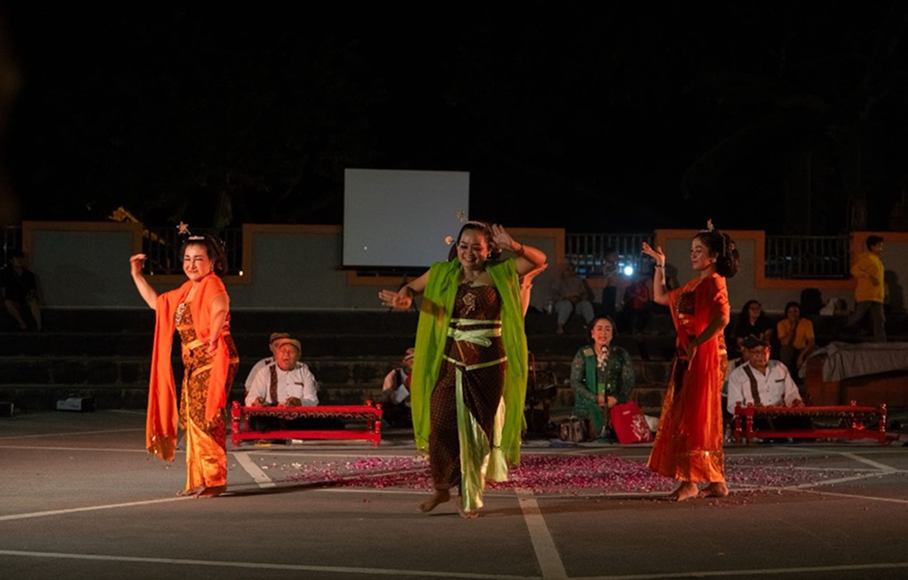
The night air was quite cold. The audience flocked to the open arena stage area at the Banyumas District office. That night, the two groups that performed to warm the night were very contrasting artistically. The first performer was a legendary Lengger group named Lengger Banjarwaru (Cilacap) with classical Lengger choreography featuring the baladewa dance (a dance of male figures played by women) accompanied by Calung music (a bamboo musical instrument). Lengger Banjarwaru managed to attract the attention of both wider and segmented art audiences with their energetic performances.
The next performer, Proto Animalia Project (Yogyakarta), is a contemporary art group that combines Lengger with video technology, electronic music (noise), and unique costumes, their faces covered by balaclavas. Their experimentation left the entire audience looking confused: “What kind of performance is it?” The confusion or distance was attempted to be solved through a participatory art approach – an art form that is becoming the mainstream of global art – which was translated into a gunungan scene (fighting over food arranged to resemble a mountain in Javanese tradition) filled with gulali (sweets). Interestingly, the wider audiences were more active (intimate) in fighting over the food than the segmented art audience. If we look back, the wider audience is not familiar with the global art scene, and in fact, this performance is too far from the daily culture of the Banyumas community, almost unrecognizable as Lengger. So what makes a performance intimate? And what is the connection with self-censorship?
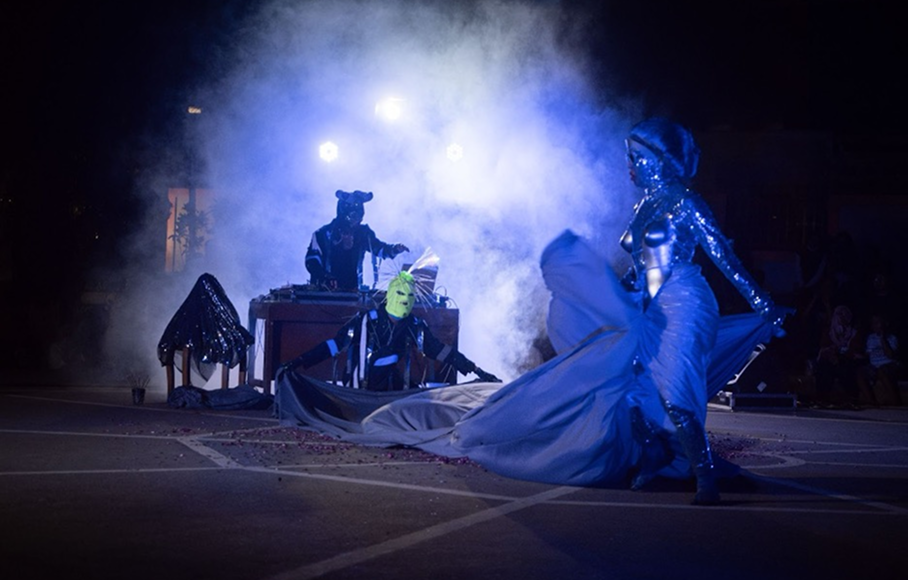
If we look further, the segmented art audience consists of art lovers, art critics, and artists who have special motives or expectations when watching the performance. It is undeniable that a set of knowledge, let's say art criticism knowledge, that is attached to an individual has an impact on their position as an audience. For example, art observers take the position of a subject standing in front of a performance (observation object). This kind of opposition of subjects-objects requires the autonomy of the subject to give meaning. It is natural that this type of audience appears cold or distances themselves from the performances due to the perception that is mediated by certain knowledge. If self-censorship is an effort to filter self-perception based on certain preferences, in this case, the construction of knowledge (academic) actually filters the emotions that are to be expressed. On the other hand, ordinary and wider audiences who do not have the burden of certain knowledge tend to be freer and more honest in expressing what they perceive.
We call this moment of raw emotion. Raw emotion is the complexity of human expression: the body, mind, emotions, senses, desires, and memories of individuals that appear naked and as they are. Intimate, dynamic, and spontaneous relationships are forms of raw emotion whose emergence is not mediated or filtered by any device (knowledge, discourse, and general provisions). In this case, wider audiences use all the features that humans have to enjoy the performance rather than prioritizing an art appreciation or art criticism approach that is not free from a certain knowledge regime. On the other hand, the raw emotions displayed by the wider audience seem to eliminate the attempts to classify and categorize art that is compartmentalized in modern art. This form of art appreciation allows us to be more intimate, honest, and free.
At a certain level, the freedom produced by raw emotions makes the wider audience become an emancipatory subject. They allow themselves to be involved in producing events (meanings) without being hindered by existing rules/orders. The productive activities of these wider audiences remind us of the Body Without Organs postulated by Deleuze, that desire is a productive machine that creates itself anew or self-threshold. Raw emotions open up opportunities for individuals to escape self-censorship and become subjects who continue to change, breaking through the provisions that often limit the subject. In other words, raw emotions can be experimented with as a compass in navigating individuals amidst the diversity of self-censorship that is increasingly difficult to recognize.
July 29th, 2023, I was walking from home with Miskha to the place in which Irfanuddien Ghozali held a theatre performance. The theatre is part of the Amuk festival, a festival that highlighted the existence of Sumodiningrat, one of the warlords during wartime in Yogyakarta, who hasn't been much exposed. The situation has also been positioned as a metaphor of historical narrative writing that excludes and includes certain parts of the narrative based on interests and other considerations.
The event was scheduled at 19:00. At 18:50, there were many people gathered at the place. The site was an old house, and some parts of the building were left abandoned and dusty, but it had a large yard. There was no stage built in there. The minutes I entered the site, I felt like I entered the Sekaten site, a local night market and festival for the public, held to commemorate the birthday of Prophet Muhammad. But it has been contextualized with local narratives, and it has been an affordable annual entertainment event for the public. But in the recent few years, the local government has replaced the night market and festival with a white cube exhibit that exposes the historical narrative of the royal family. The replacement of a public festival with an exhibition has brought up the sense of loss that I did not recognize until the day I went to the site of the theatre performance. In other words, the first feeling of entering the site was the feeling of being in Sekaten. This situation has helped me recognize my feeling of loss and longing for the vibe of the public festival of Sekaten.
From this experience, I realized one thing, that sometimes we are conditioned not to recognize our own feelings. In other words, we are alienated from our own feelings. Apart from the story built through the plot, the situation, the mood and the vibe created in the theatre site have helped me reconnect with my own feeling.
From the elaborations in each keyword, we basically try to reflect our positions, and our views, as a subject amidst the powers operated around us. From public space as a performative site, in which we watch and are watched, in which we feel and make space, in which we connect and reconnect. From the censorships and cancellations of certain art events and artworks, we can highlight that the character of the regime was oppressive, racist, and always worried. Since we can find many unexpected experiences in artworks/art events.
From the elaborations in each keyword, we were also trying to dismantle our question about the character of the censorship regime. It's true that the 1998 movement has replaced the president with the new one, but has the underlying structure of feeling of the new order regime been fully replaced or stayed the same?